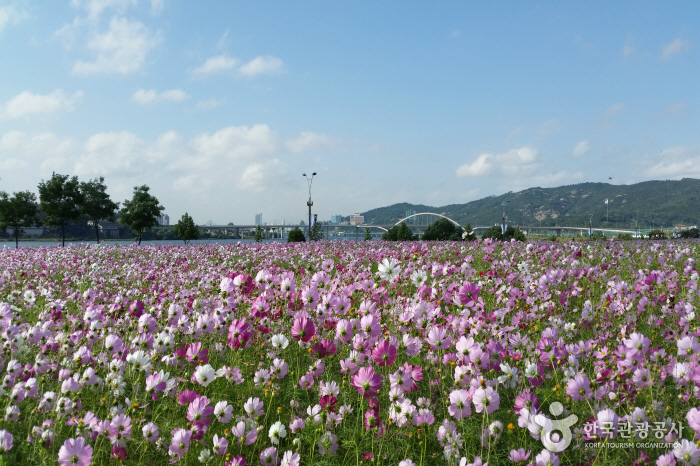
Guri Hangang Park (Cosmos Park) (구리시민한강공원 (코스모스공원))
Guri Hangang Park (Cosmos Park) (구리시민한강공원 (코스모스공원))
 – Homepage
www.guri.go.kr
– Tel
+82-31-550-2474
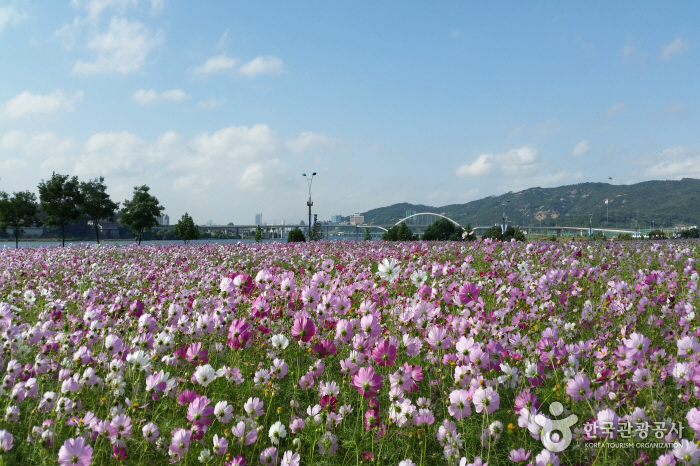
Guri Hangang Park offers a perfect rest area for visitors where visitors can feel the cool breeze coming off the river and rest amidst the beautiful natural scenery. The park’s bounties of flowers are at their peak in May with field of canola flowers, and in September when the cosmos bloom.
– Address : Topyeong-dong, Guri-si, Gyeonggi-do
※ Presentation Information
– Information and Guides
• 1330 Travel Hotline: +82-2-1330
(Korean, English, Japanese, Chinese)
• For more info: +82-31-550-2474,
+82-31-550-2107
– Parking
Available
– Available Facilities
Bike path, stream, walking path, etc.
– Restrooms
Available


◎ Nearby Tourism Infobox
⊙ Jangja Lake Park (장자호수공원)
View detailed guide on Korea Trip Guide →
– Homepage
www.guri.go.kr/culture
– Tel
+82-31-550-2472
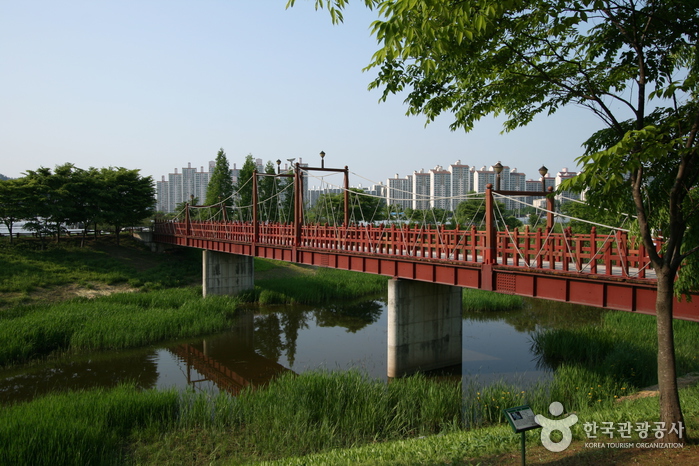
Guri City worked to improve the water quality of Jangja Lake in order to form the Jangja Lake Park and in the process an ecological zone was created. A 3.6 km tree-lined walking trail runs through the park and is frequently used by people enjoying an outing or getting some light exercise. Concerts, exhibitions, and other events are held on the outdoor stage on weekends and the park is widely used as a place to relax by local residents.
* Size – Area 107,385 m², average water depth 2.2 m (0.2 m~4.7 m), and walkway 4.6 km
⊙ Godeok-dong Ecological Landscape Conservation Area (고덕동 생태경관 보전지역)
View detailed guide on Korea Trip Guide →
– Homepage
hangang.seoul.go.kr
– Tel
+82-3780-0848
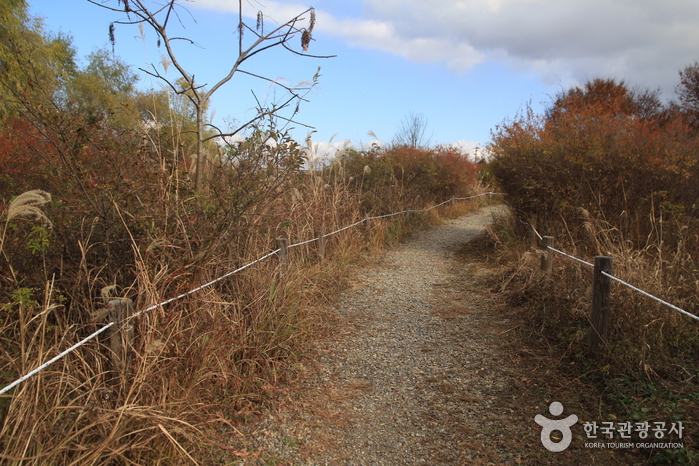
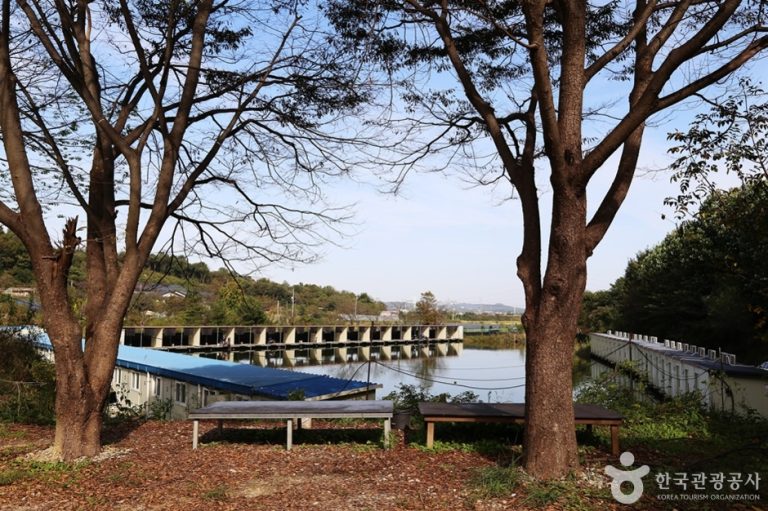
Located next to the Godeok Riverside Restoration Area, the Godeok-dong Ecological Landscape Conservation Area is one of the most well-maintained ecological preservation sites in Seoul. The area includes Amsa Sluice Gate, Hoan, and Hangang River Reservoir. The area offers educational facilities for visitors to learn more about the ecosystem.
⊙ Olive Young – Guri Sutaek Branch [Tax Refund Shop] (올리브영 구리수택점)
–
⊙ Archaeological Site in Amsa-dong, Seoul (서울 암사동 유적)
View detailed guide on Korea Trip Guide →
– Homepage
www.sunsa.gangdong.go.kr
– Tel
+82-2-3425-6520
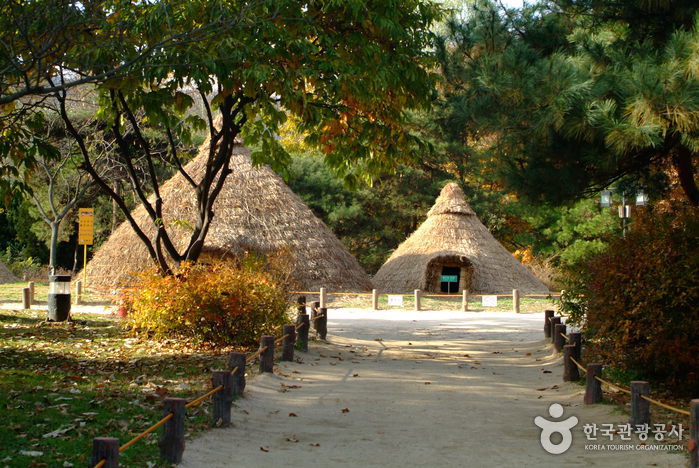
The Archaeological Site in Amsa-dong reproduces the lifestyle of the Neolithic Era. Even the entrance gate is shaped like a huge dolmen and the trash cans are ancient diagonal-line patterned earthenware. Archaeological Site in Amsa-dong was excavated in 1925 when a flood washed away the soil on the banks of the Hangang River and exposed a large number of diagonal-line patterned earthenware. After several excavations, the Archaeological Site in Amsa-dong was established.
The site was a location for a massive colony, thus many ancient buildings, stone axes and stone arrows have been uncovered as well as countless diagonal-line patterned earthenware. The housing site is round with a spot in the center for fire. The site is colossal and possesses nine mud huts, two exhibition halls displaying ancient artifacts and an open mud hut where visitors can experience life in the Neolithic Era. The site offers many attractions such as mud huts and promenades. Archaeological Site in Amsa-dong is also very educational for children and families who want to learn and experience the Neolithic Age.
⊙ Amsa-dong Prehistoric Site Museum (암사동선사유적박물관)
View detailed guide on Korea Trip Guide →
– Homepage
http://sunsa.gangdong.go.kr
The archaeological sites in Amsa-dong, Seoul, were a collective settlement where people lived during the Neolithic Age about 6,000 years ago and became known to the world after the sand dunes along the Hangang River caved in during the great flood of 1925, exposing numerous pieces of comb-patterned pottery. The area designated as a historic site in 1979, and excavation of the site took place from 1981 to 1988. The cultural heritage protection area was expanded to a total area of 78,133㎡. Currently, nine Neolithic dugout huts and one experiential dugout hut have been restored. The exhibitions currently open to the public are Exhibition Hall 1, which displays a restoration of a Neolithic Age dugout, and Exhibition Hall 2, which displays various panels and models to help understand the prehistoric era as a whole.
![New Balance Kids – Lotte Ansan Branch [Tax Refund Shop] (뉴발란스 키즈 롯데안산)](https://ktrip.blogsailing.com/wp-content/uploads/2025/12/2882016_image2_1-768x432.jpg)
![LG Best Shop – Namsuwon Main Branch [Tax Refund Shop] (엘지베스트샵 남수원 본점)](https://ktrip.blogsailing.com/wp-content/uploads/2026/01/2890277_image2_1-768x576.jpg)
![Olive Young – Yongin Gwanggyo Branch [Tax Refund Shop] (올리브영 용인광교)](https://ktrip.blogsailing.com/wp-content/uploads/2026/01/2888765_image2_1.jpg)
![Agabang – Newcore Sanbon Branch [Tax Refund Shop] (아가방 뉴코아 산본점)](https://ktrip.blogsailing.com/wp-content/uploads/2025/12/3314535_image2_1.jpg)
One Comment