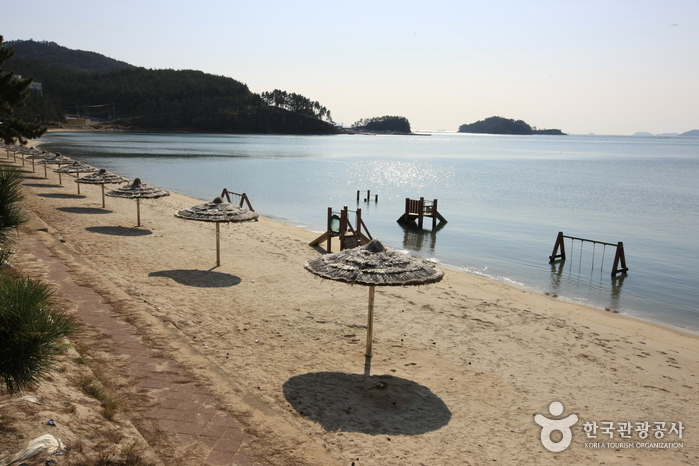
Songho Beach (송호해수욕장)
Songho Beach (송호해수욕장)
 – Homepage
www.haenam.go.kr
– Tel
+82-61-532-1330
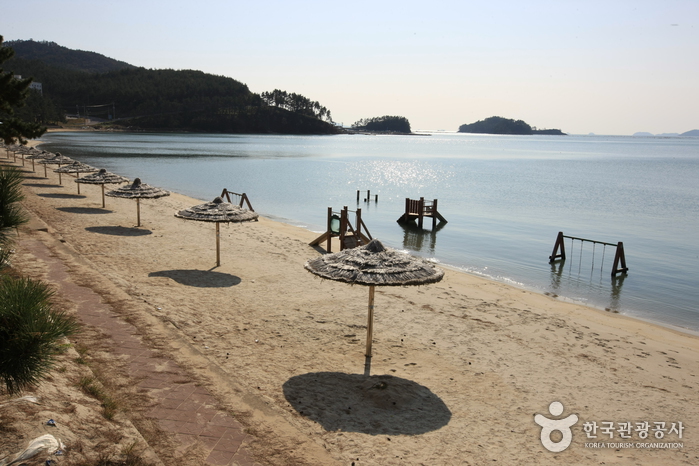
Songho Beach is the most representative beach in Haenam and was named so for its dense old pine trees, fine sand, and shallow water resembling a lake. The fine sand and shallow waters make it the perfect beach for families. Hundreds of pine trees create a scenic forest reaching almost 1 kilometer along the levee which provides a suitable camping site under in the forest. The Ttangkkeut Trail that starts from Songho Beach auto-campgrond connects to Galsan Village and Ttangkkeut Tower.
The windbreak pine forest in Songho-ri, Haenam is designated as Jeollanam-do Natural Monument, consisting of at least 600 pine trees aged 200 years that play a vital role in the coastal shelterbelt.
– Address : 1827, Ttangkkeutaean-ro, Haenam-gun, Jeollanam-do
※ Presentation Information
– Information and Guides
• 1330 Travel Hotline: +82-2-1330
(Korean, English, Japanese, Chinese)
• For more info: +82-61-532-1330
– Parking
Available
– Day Off
N/A (Open all year round)
– Restrooms
Available
– Available Facilities
Accommodations, campground, auto campground (10 caravans), parasol rentals, shower booths, drinking fountains, etc.


◎ Nearby Tourism Infobox
⊙ Ttangkkeut Sunset & Sunrise Festival (땅끝 해넘이해맞이축제)

– Homepage
tour.haenam.go.kr
– Tel
+82-61-530-5159
Ttangkkeut Sunset & Sunrise Festival is held annually from December 31 to January 1 at Ttangkkeut Village in Haenam-gun, Jeollanam-do. The festival includes a sunset and sunrise ceremony. The festival is famous for the unique view of the sunrise between Hyeongjebawi Rocks next to Galduhang Port.
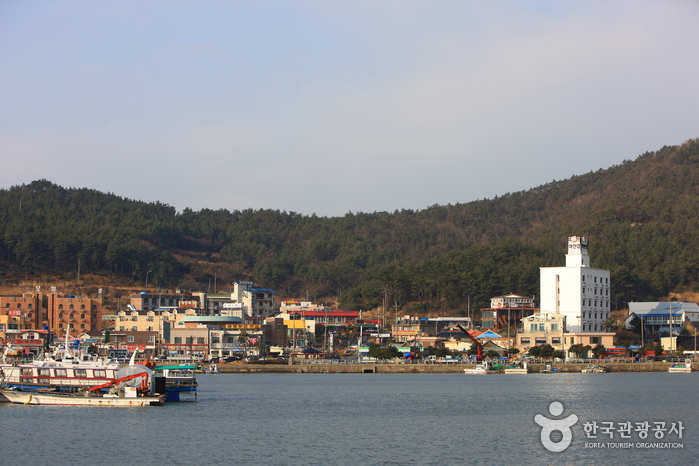
⊙ Galdu Village (Ttangkkeut Village) (갈두마을 (땅끝마을))
View detailed guide on Korea Trip Guide →
– Tel
+82-61-532-3883
Galdu Village, also referred to as Ttangkkeut (Land’s-end) Village in Haenam-gun, Jeollanam-do is at the southernmost point of the Korean peninsula. The island has an observatory at Sajabong Peak, where one can get an unobstructed view of the southern archipelago, and even a glimpse of Hallsan Mountain on Jeju Island on a clear day. The name “galdu” originated from the Chinese characters for arrowroot, which was commonly found in the nearby mountains.
](https://ktrip.blogsailing.com/wp-content/uploads/2025/11/2592528_image2_1.jpg)