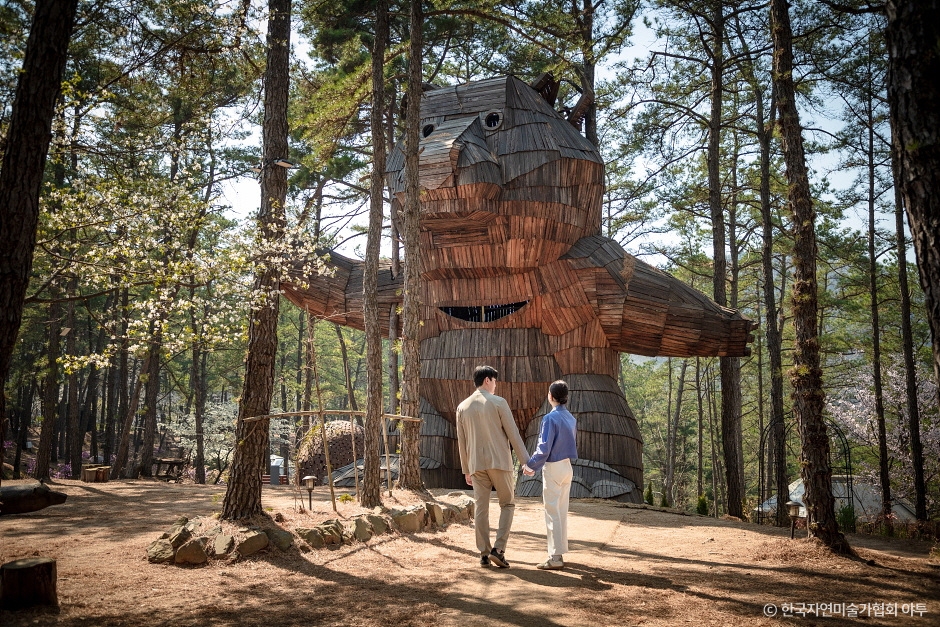
Yeonmisan Nature Art Park (연미산자연미술공원)
Yeonmisan Nature Art Park (연미산자연미술공원)
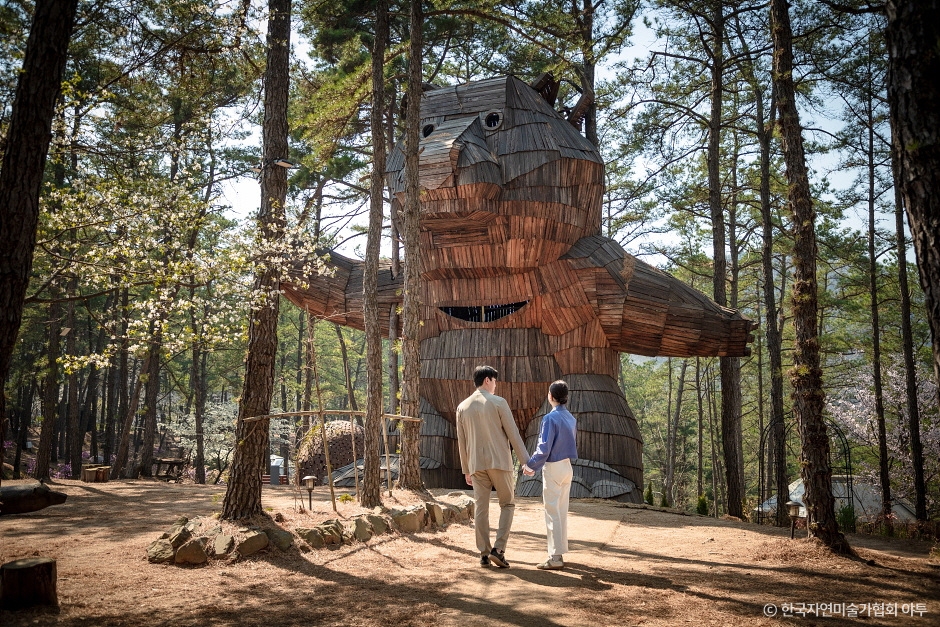 – Homepage
www.natureartbiennale.org
Yeonmisan Nature Art Park features sculptures created from natural materials, such as clay, wood, and stone. The park exhibits new works each year under different themes as part of the Geumgang Nature Art Biennale, an international festival of nature art. It includes indoor and outdoor exhibitions, as well as a promotion hall. Visitors can participate in experience programs such as woodcraft workshops and nature art school activities.
– Address : 98 Yeonmisangogae-gil, Useong-myeon, Gongju-si, Chungcheongnam-do
※ Presentation Information
– Experience Guide
Nature Art School
– Information and Guides
+82-41-853-8828
– Parking
Available
– Day Off
Mondays, December-February
– Operating Hours
March-October 10:00-18:00 / November 10:00-17:00
– Restrooms
Available
– Admission Fees
Adults 5,000 won / Teenagers & children 3,000 won


◎ Nearby Tourism Infobox
⊙ Gongju Hanok Village (공주한옥마을)

– Homepage
http://www.gongju.go.kr/hanok
– Tel
+82-41-881-2828
Gongju Hanok Village is in Gongju, Chungcheonnam-do, midway between the Songsan Ancient Tombs – burial place of King Muryeong of Baekje and his queen – and Gongju National Museum. The hanok are ondol-heated and have a card key security system. The village offers both individual and group accommodation, each in a different building; in the group buiding each room has a separate locker room and shower. Baekje history and culture programs on offer include a Baekje costumes experience, a royal tea ceremony, royal candies and Baekje relics.
⊙ Gongju National Museum (국립공주박물관)

– Homepage
gongju.museum.go.kr
– Tel
+82-41-850-6300
Gongju National Museum preserves and displays cultural treasures, as well as provides educational programs for locals. The museum collection includes over 10,000 relics, including 19 National Treasures and three Treasures, all excavated from the Chungcheongnam-do & Daejeon areas. The most important of these artifacts are displayed permanently, while the remaining items rotate with special exhibitions. In front of the main building is a garden visitors can enjoy after touring the museum.
⊙ Baekje Experience Center (백제오감체험관)
– Homepage
www.gongju.go.kr
The Baekje Experience Center offers a rich array of activities that allow visitors to engage with the history they have observed at the nearby ancient tombs in Songsan-ri and the Gongju National Museum in a tactile manner. This center features eight themed halls across the first basement, and the first and second above-ground floors, offering interactive and gaming programs designed to stimulate all five senses. Activities such as rubbing pattern experience and luminous stamps allow visitors to learn about and appreciate the culture and history of Woongjin Baekje in an intuitive way. One of the center’s highlights is the Window of Sympathy in the first-floor lobby. This impressive two-story panel changes its color in response to sound and touch, promising to attract significant attention from tech-savvy visitors. It showcases content that guests have captured within the center and shared on social media, complete with hashtags. Additionally, the Window of Creation on the same floor offers a unique creative outlet. Here, visitors can color Baekje-era relics with crayons. These artworks are then transformed into graphic mapping images on the wall via a scanner, allowing for a personalized and immersive historical experience.
⊙ Gongju Tomb of King Muryeong and Royal Tombs [UNESCO World Heritage] (공주 송산리 고분군과 무령왕릉 [유네스코 세계문화유산])

– Homepage
www.gongju.go.kr
www.cha.go.kr
The Songsan-ri Tombs and Royal Tomb of King Muryeong (r. 462-523) contain representative relics of the Baekje period (234-678). The Songsan-ri Tombs contain the graves of kings from the period when Baekje’s capital was Gongju, and it is believed to contain 17 such graves. Only seven graves have been discovered so far. There are two types of tomb designs: traditional Baekje-style rock and earth fortification tomb and Chinese-influenced rock tomb. The tombs number one to five were made using the traditional Baekje-style design while tomb number six and the Royal Tomb of King Muryeong were made using the Chinese-influenced design. Even though many artifacts were stolen from the tombs, the tombs serve as an important evidence of Baekje culture and the foreign exchanges from during that period.
![Haebial Pool Villa [Korea Quality] 해비알풀빌라 [한국관광 품질인증]](https://ktrip.blogsailing.com/wp-content/uploads/2025/12/2950387_image2_1-768x401.jpg)
![Hottracks – Cheonan Branch [Tax Refund Shop] (핫트랙스 천안점)](https://ktrip.blogsailing.com/wp-content/uploads/2025/12/2883221_image2_1-768x576.jpg)
![Lotte Himart – Dangjin Lotte Mart Branch [Tax Refund Shop] (롯데하이마트 당진롯데마트점)](https://ktrip.blogsailing.com/wp-content/uploads/2025/12/2883315_image2_1-768x432.jpg)