Bonggil Daewangam Beach (봉길대왕암해변)
Bonggil Daewangam Beach (봉길대왕암해변)
– Homepage
www.gyeongju.go.kr
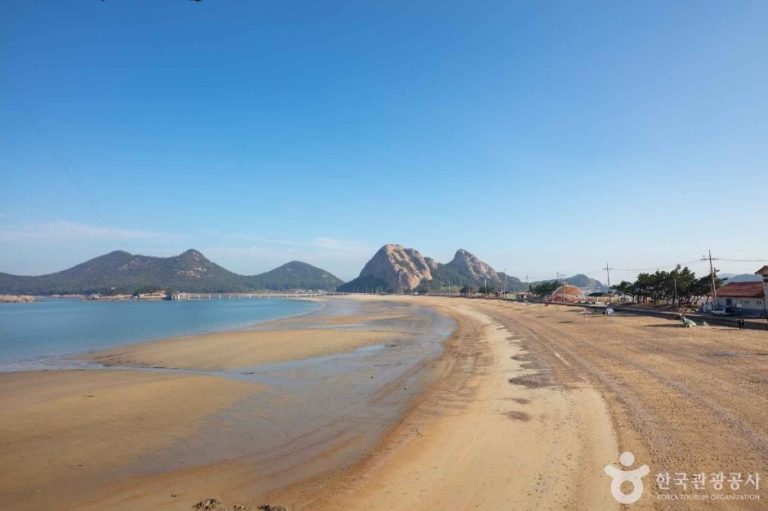
Bonggil Daewangam Beach, located 32 kilometers east of downtown Gyeongju is a white sand beach with an average water temperature of 22℃. It is less crowded compared to other beaches on the East Coast, making it a perfect destination for a leisurely getaway. In summer, beach bungalows, tube rental shops, snack shops, and other convenience facilities are available. From the beach, visitors can also see the Tomb of King Munmu, which lies 200 meters offshore.
– Address : Bonggilhaean-gil, Yangbuk-myeon, Gyeongju-si, Gyeongsangbuk-do
※ Presentation Information
– Age Range
Open to visitors of all ages
– Information and Guides
+82-54-779-6324
– Parking
Available
– Day Off
N/A (Open all year round)
– Restrooms
Available
◎ Nearby Tourism Infobox
⊙ Tomb of King Munmu (경주 문무대왕릉)
View detailed guide on Korea Trip Guide →
– Homepage
www.gyeongju.go.kr
A little rocky islet approximately 200 meters from the shore at Bonggil-ri is the Tomb of King Munmu (AD 661-681), who unified the three kingdoms and became the 30th ruler of the Silla Kingdom. The king gave specific instructions to be buried in the East Sea after his death so that he would become a dragon and protect Silla from foreign invaders. The rocky island, about 200 meters in circumference, is divided by a cross-shaped waterway, forming a pool at the center, at the bottom of which is a granite stone 3.6 meters long, 2.9 meters wide and 0.9 meters thick. Legend has it that the remains of King Munmu’s cremated body are buried under this rock. Historians still debate whether the ashes of the King Munmu were scattered or stored in an urn and placed under the rock.
⊙ Gameunsaji Temple Site (경주 감은사지)
View detailed guide on Korea Trip Guide →
– Homepage
www.gyeongju.go.kr/tour (Korean, English, Japanese, Chinese)
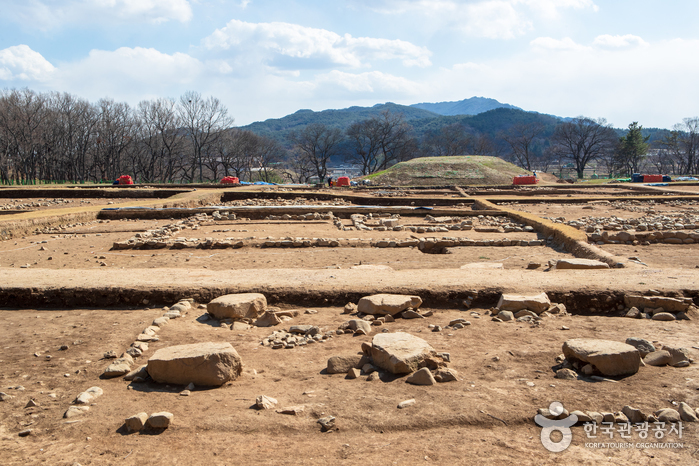
Gameunsaji Temple Site was built by King Munmu (AD 661-681), the king of Silla who unified Baekje and Goguryeo in the late 7th century. The purpose of the temple site was to pray for help and guidance from Buddha against Japanese invasion. Unfortunately, King Munmu passed away before the completion of the temple, and left a will to be cremated and buried in the East Sea so that he may reincarnate as a sea dragon in order to protect the country. As he wished, King Munmu’s ashes were scattered at Daewangam of the East Sea. The temple was completed and was named by his son, King Sinmun (AD 681-692) in respect and appreciation for his father.
Gameunsaji Temple Site was rebuilt in 1979 based on the discovery of the site’s foundation after two years of archeological research. The three-story stone pagoda at the temple site is a reminent of the early period of unified Silla, assembled with several parts which rise up to 13.4m high, known to be Silla’s highest three-story pagoda.
![Artbox – Gyeongju Branch [Tax Refund Shop] (아트박스 경주)](https://ktrip.blogsailing.com/wp-content/uploads/2025/12/2883743_image2_1.jpg)
![Seonginbong Primeval Forest [National Geopark] (성인봉 원시림 (울릉도, 독도 국가지질공원))](https://ktrip.blogsailing.com/wp-content/uploads/2025/12/2370057_image2_1.jpg)