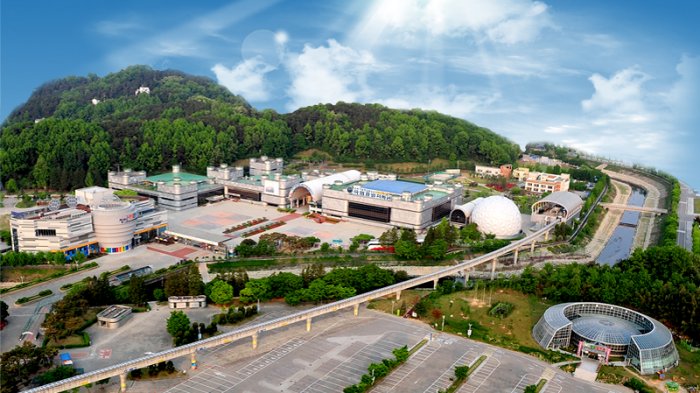
National Science Museum (국립중앙과학관)
National Science Museum (국립중앙과학관)
 – Homepage
www.science.go.kr
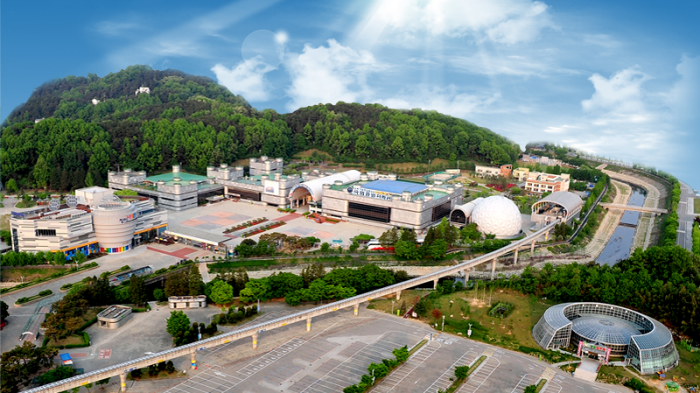
The National Science Museum collects and exhibits various scientific materials. The outdoor exhibition features large models including airplanes, propellers, airboats and more as well as rest areas. The special exhibition hall displays the work of various contest winners as well as rare products. The permanent exhibition hall offers approximately 4,200 works from 322 subjects in four different fields. The observatory hall in a dome-shaped structure has a 70-millimeter-long astro-vision as well as a planetarium. Various programs are offered including HAM radio, education and experience class, model plane class, and computer class, as well as other science education programs and events.
– Address : 481 Daedeok-daero, Yuseong-gu, Daejeon
※ Presentation Information
– Information and Guides
+82-42-601-7979
– Parking
Available
– Parking Fee
3,000 won for first 5 hours; 500 won for each additional 30 minutes
– Day Off
Mondays (closed the following day if Monday is a public holiday), January 1, the day of Seollal (Lunar New Year’s Day) & Chuseok (Korean Thanksgiving Day)
– Usage Fee
Varies by exhibition; refer to the website
– Operating Hours
09:30-17:50
– Scale
Land area: 165,290 ㎡
Building area: 28,826 ㎡
Exhibition area: 21,421 ㎡


◎ Nearby Tourism Infobox
⊙ Tower of Great Light (Hanbit Tower) (한빛탑)
View detailed guide on Korea Trip Guide →

– Homepage
www.djto.kr
The Tower of Great Light(Hanbit Tower) is an observatory located in the Expo Science Park in Daejeon. The tower is a symbolic sculpture built to commemorate the Daejeon Expo held in 1993, and is called the Hanbit Tower because it is a ray of light that connects the present and the future. The 93-meter-high Hanbit Tower offers a bird’s-eye view of the Expo Science Park and major areas of Daejeon. On the first floor, the Exhibition Room displays photos and audio-visual videos of major tourist attractions symbolizing Daejeon.
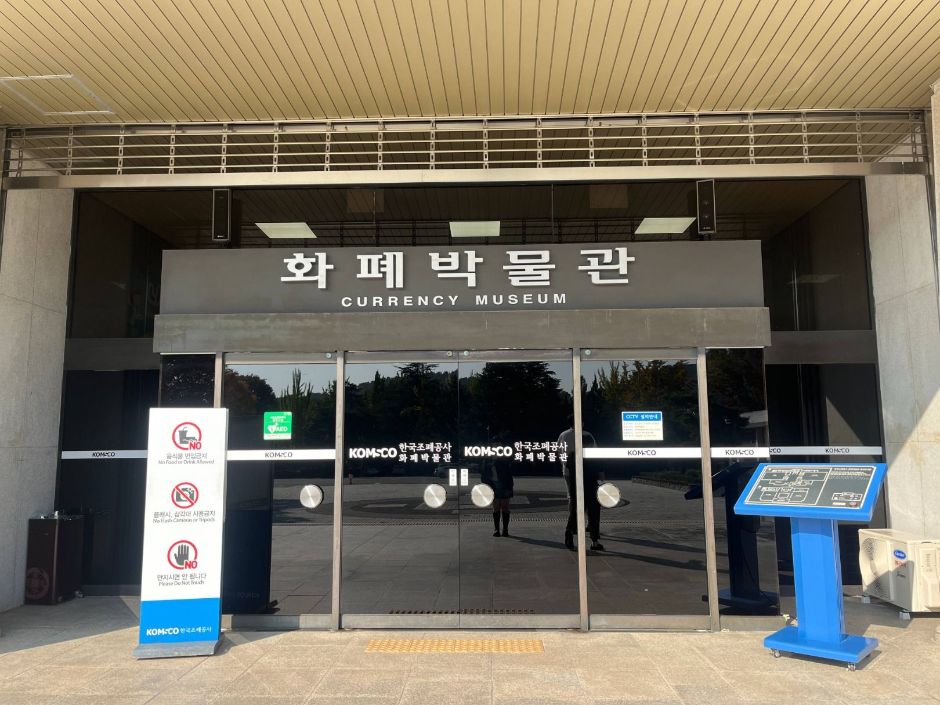
⊙ Currency Museum of Korea (화폐박물관)
– Homepage
museum.komsco.com
The Currency Museum of Korea, established in 1988, is operated by the Mint Corporation of Korea as part of its non-profit public services and is open to visitors free of charge with a view of increasing public knowledge of the nation’s currency. The museum features about 120,000 pieces including: coins currently in use both in Korea and overseas; coins from modern times (from the Late Joseon Dynasty until today); 80 types of commemorative coins; 88 types of ‘special money’; postage stamps, and other materials. Additionally, there is an experiential space where visitors can learn about the currency production process and its historical significance, providing significant educational benefits.
⊙ Daejeon Expo Aquarium (대전 엑스포 아쿠아리움)
View detailed guide on Korea Trip Guide →

– Homepage
www.djexpoaqua.com
Daejeon Expo Aquarium combines living marine life with media art. It is themed around the sea in Greek mythology, incorporating the story of Poseidon, the god of the sea, into its exhibits. Visitors can enjoy performances such as underwater ballet, feeding shows, and magic, along with activities like sea exploration boat rides, seawalker experiences, scuba diving, fish feeding, and 5D experiences.
⊙ Daejeon Shinsegae Art & Science (대전신세계 Art & Science)
View detailed guide on Korea Trip Guide →
– Homepage
www.shinsegae.com
Daejeon Shinsegae Art & Science is a culture and art complex containing cultural and art contents and the identity of Daejeon as the science capital of Korea. It was designed by a consortium of the Shinsegae Group and Kyeryong Construction Industrial and was built with five underground floors and 43 ground floors over a section of the Expo Science Park site. The complex consists of Podium (department store building) and Tower. As you can see from its name, “Art & Science,” it offers diverse contents that combine Shinsegae’s unique culture and art as well as future science and technology, from “Shinsegae Nexperium,” a science museum designed together with professors from KAIST and “Sports Monster,” the first indoor sports theme park in the region, to an aquarium with a 4,200t tank that utilizes digital media and a rooftop garden with a panoramic view of Gapcheon Stream. All of these contents that were not able to be experienced in the past attract young visitors in their 20s and 30s. In addition, it introduces exhibits of famous galleries and seeks the growth of Daejeon culture and arts through collaboration with local artists.
⊙ Smob – Daejeon Branch (스몹 대전)

– Homepage
www.smob.co.kr
Smob is the world’s first adult playground, featuring 25 attractions based on various sports that are enjoyable for everyone, including those who aren’t particularly athletic or interested in sports.
⊙ Daejeon Expo Park (대전엑스포과학공원)
View detailed guide on Korea Trip Guide →

– Homepage
www.djto.kr
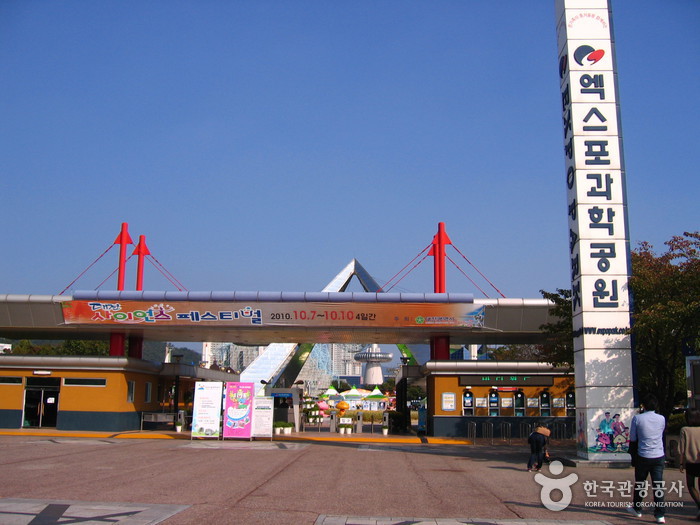
Daejeon Expo Park was established following the closing of the Daejeon Expo in 1993. The park comprises various facilities like the Hanbit Tower, the representative tower of Daejeon World Expo, and a water plaza with a musical fountain. At night, a fabulous media facade and special lighting effects create an awesome scene against the backdrop of Hanbit Tower.
⊙ Yuseong Special Tourist Zone (유성 관광특구)
View detailed guide on Korea Trip Guide →
– Homepage
www.yuseong.go.kr
Daejeon is the center of state-of-the-art science and technology in Korea, where the nation’s top-tier venture enterprises, including Daedeok Special Research and Development Zone, run their businesses. As the representative city of science and technology for the nation, it is comparable to Silicon Valley in the United States.
Yuseong Special Tourist Zone, which is located in Daejeon Metropolitan City, has won a nationwide reputation as a tourism and resort district rich in hot springs and tourism resources. Yuseong Special Tourist Zone includes a hot springs water source that yields high quality water in copious streams; therefore, there is no need to dilute the water or raise the temperature.
With its healing effect proven, Yuseong Hot Springs has been the place for treatment and recuperation since the Three Kingdoms Period, and today, it is a popular travel destination for those seeking rest. The water is supplied to the hotels and other hot springs in the zone, and there are many restaurants serving a variety of dishes. There is also a facility where visitors can take a foot bath for free. Since Gyeryongsan National Park is near Yuseong-gu District, hikers take the opportunity to visit the nearby hot springs.
Science museums and pavilions, including Expo Science Park, around Yuseong Special Tourist Zone are popular destinations for families with children. Bordered by Gongju City which was the capital of Baekje during the period of Three Kingdoms, visitors can see the cultural heritage of Baekje.
* Current State of Yuseong Special Tourist Zone
1) Districts Covered: Areas around Yuseong Hot Springs and Expo Science Park (Jangdae, Guam, Gung, Eoeun, Doryong and Bongmyeong-dong, Yuseong-gu, Daejeon)
2) Area: 5,858,972 ㎡
* Tourist Attractions
Yuseong Hot Springs, Daedeok Science Complex, Kumdori Land, Expo Science Park, Art Museum, museums, ferry tour, amusement park, etc.
⊙ Hanbat Arboretum (한밭수목원)
View detailed guide on Korea Trip Guide →
– Homepage
www.daejeon.go.kr
Hanbat Arboretum, linked with the Government Complex-Daejeon and Science Park, is the largest man-made urban arboretum in Korea. It serves multiple purposes: a reservoir of genetically diverse foliage, an eco-learning center for students, and a recreational area where people can relax and pass the time in the peaceful embrace of nature. The arboretum, standing on a lot measuring 387,000 square meters, is divided into three sections. The West Garden and Nammun Square opened on April 28th, 2005. The East Garden opened on May 9th, 2009, and consists of 19 uniquely themed parks, including the Magnolia Garden, Medicinal Herbs Garden, Rock Garden, and Fruit Garden.
⊙ Daejeon Museum of Art (대전시립미술관)
– Homepage
www.daejeon.go.kr
Daejeon Museum of Art offers visitors the chance to appreciate contemporary Korean artworks. It includes exhibition halls, a storage facility, an outdoor garden, a lounge, and a gift shop. The collection features paintings, sculptures, photographs, and crafts. Its exhibitions range from permanent collections, storage displays, and contemporary art showcases. It also offers hands-on activity programs, such as printmaking, folk painting, Korean paper art, traditional dyeing, embroidery crafts, and pen drawing.
](https://ktrip.blogsailing.com/wp-content/uploads/2026/06/4028212_image2_1.jpg)
![Golden Goose – Hyundai Premium Outlets Daejeon Branch [Tax Refund Shop] (골든구스 현대프리미엄아울렛 대전점)](https://ktrip.blogsailing.com/wp-content/uploads/2026/06/4044500_image2_1.jpg)
![Eider – Hyundai Premium Outlets Daejeon Branch [Tax Refund Shop] (아이더 현대프리미엄아울렛 대전점)](https://ktrip.blogsailing.com/wp-content/uploads/2026/06/4044517_image2_1.jpg)
![BEANPOLE Ladies – Shinsegae Art & Science Branch [Tax Refund Shop] (빈폴레이디스 대전신세계 Art&Science점)](https://ktrip.blogsailing.com/wp-content/uploads/2026/06/4023486_image2_1.jpg)
![Moncler – Hyundai Premium Outlets Daejeon Branch [Tax Refund Shop] (몽클레르 현대프리미엄아울렛 대전점)](https://ktrip.blogsailing.com/wp-content/uploads/2026/06/4023498_image2_1.jpg)
2 Comments