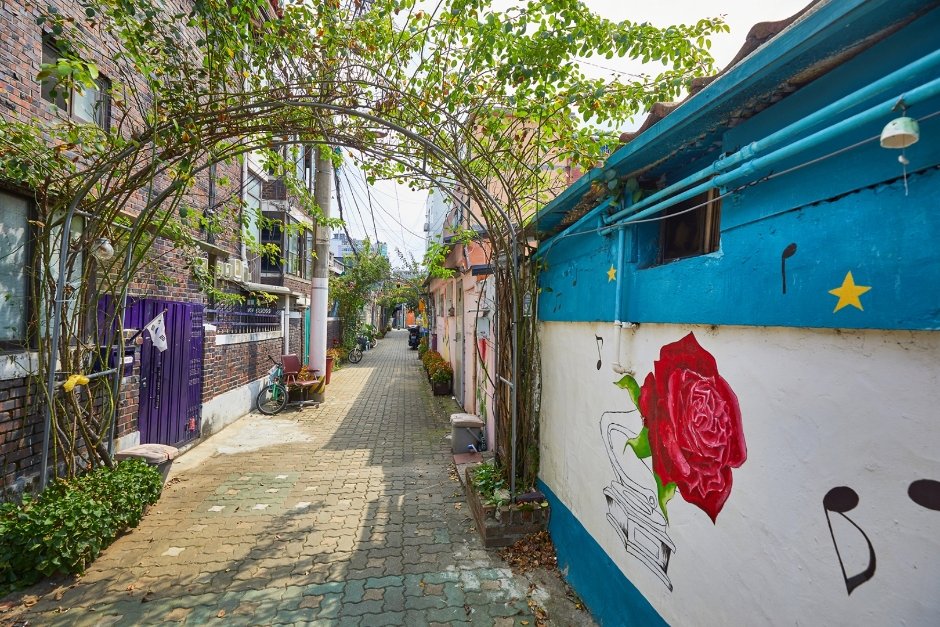
Cheonho-dong Rose Village (천호동 장미마을)
Cheonho-dong Rose Village (천호동 장미마을)
 Cheonho-dong Rose Village is a place where visitors can see the old neighborhoods of Seoul and the roses that adorn every wall. The small old houses convey the nostalgia of 30 to 40 years ago, and the red and pink roses in full bloom in every house welcome travelers. The street is narrow, but thanks to the residents’ careful maintenance, it has become a famous rose attraction and photo spot. The rose season peak from May to June, forming a tunnel of roses. There is also mural that recreates a scene from the novel “The Little Prince,” giving the area a poignant atmosphere. Rose Village is located about 250 meters from Cheonho Station (Seoul Subway Line 5), Exit 1. Visitors are advised to be respectful and to keep the noise level down while touring the area as it is a residential village.
– Address : Cheonho-dong, Gangdong-gu, Seoul
※ Presentation Information
– Information and Guides
Gangdong-gu Office +82-2-3425-5250
– Parking
Not available
– Day Off
N/A (Open all year round)
– Operating Hours
Open 24/7

◎ Nearby Tourism Infobox
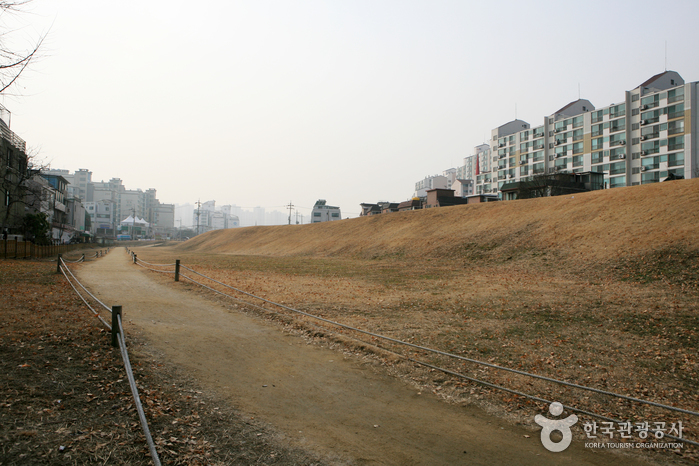
⊙ Pungnap-dong Toseong Fortress (서울 풍납동 토성)
View detailed guide on Korea Trip Guide →
– Homepage
culture.songpa.go.kr (Korean, English, Japanese, Chinese)
Onjo, the progenitor of Kingdom Baekje, first settled in Wiryeseong Hanam. But exact location is still unknown. One thing for sure, however, is that Pungnaptoseong Fortress, Mongchontoseong Fortress, Bangidong Ancient Tombs of Baekje, Seokchondong Stone Mound Tomb of Early Baekje are the remains of Baekje. Pungnaptoseong Fortress faces Hangang River to its west and connects to Mongchontoseong Fortress to the south. To the northwest faces Achasanseong Fortress over Hangang River and far to the southeast is Namhansanseong Fortress.
Pungnaptoseong Fortress, located at the south end of Cheonhodaegyo Bridge over Hangang River, is one of the remains of Early Baekje. Originally, the fortress was 4km in circumference, but due to massive overflowing of Hangang River during flood season in 1925, most of the fortress was lost and only 2.7km of it remains. To the east of the fortress are 4 vestiges of the fortress gates. The remains from the prehistoric era through the Samguk (Three States) era have been unearthed, indicating that this place was a residential area well before the Baekje Era. Through vigorous excavation, some people suggest that there used to be a palace located here during the Baekje Era.
⊙ Seoul Miz Hospital (서울미즈병원)
View detailed guide on Korea Trip Guide →
Seoul Miz Hospital is a women’s specialized hospital located in Gangdong-gu, Seoul. It provides medical services in obstetrics and gynecology, breast and thyroid surgery, internal medicine, dermatology and plastic surgery, and pediatrics, while also operating a health promotion center. With its newly expanded building, the hospital has established an International Medical Center to support the treatment of foreign patients.
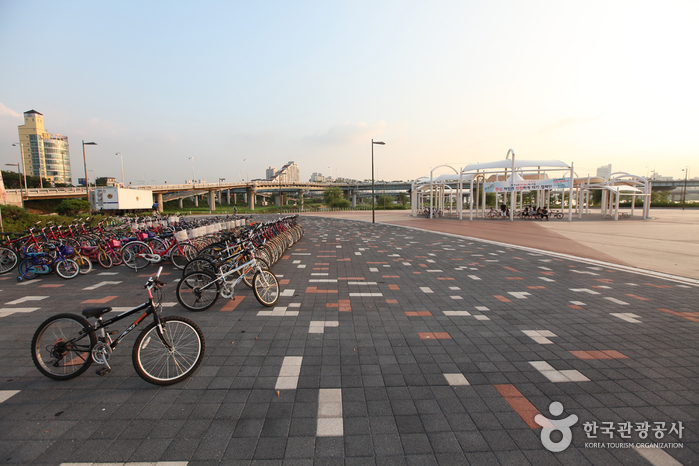
⊙ Gwangnaru Hangang Park (광나루한강공원)
View detailed guide on Korea Trip Guide →
– Homepage
hangang.seoul.go.kr
Hangang Citizen’s Park, composed of 12 areas including Jamsil, Ttukseom and Jamwon, is an eco-friendly park providing areas for sports and leisure. The park is equipped with various cultural and recreational facilities and also has an ecological park. Gwangnaru Hangang Park formed naturally through rich silt that flowed in from the upper Hangang River that was then filled with reeds, creating an ideal habitat for groups of migratory birds.
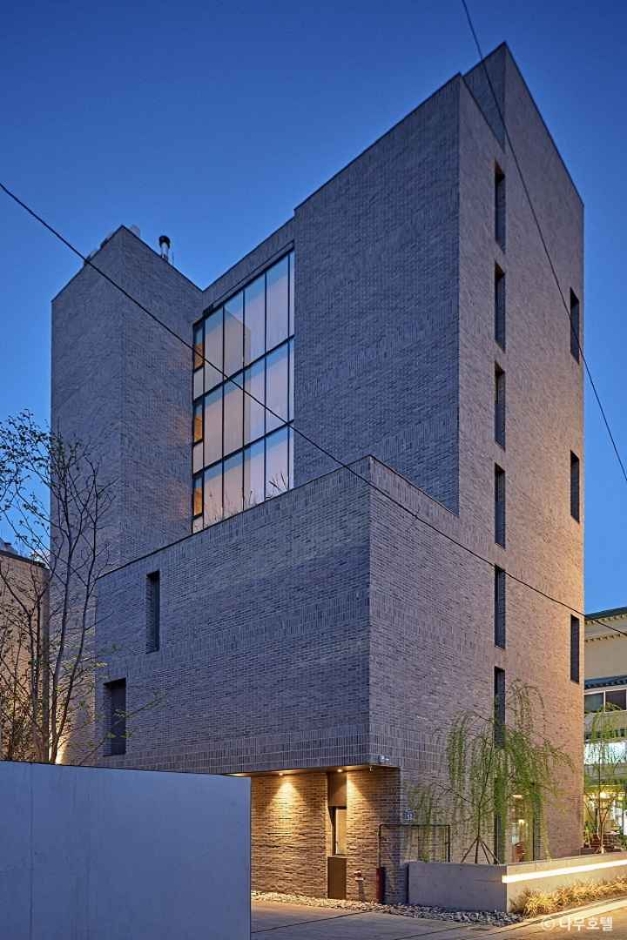
⊙ Namu Hotel (나무호텔)
View detailed guide on Korea Trip Guide →
– Homepage
https://www.stayfolio.com/findstay/namu-hotel
Namu Hotel, which received the Institute of Architects Award, is a hotel with a distictive design. Rather than having the main entrance on a main road, the hotel must be entered through the alley. Each room has its own unique style in terms of structure and furniture arrangement. Most rooms also feature a blacony that allows guests to be one with nature while also being protected from outside forces. Enjoy a soak in the outdoor bathtub to relax.
⊙ Grand Walkerhill Riverpark (Outdoor swimming pool) (그랜드 워커힐 리버파크 수영장(야외수영장))
View detailed guide on Korea Trip Guide →
– Homepage
www.walkerhill.com
Grand Walker Hill Riverpark is a swimming pool using water comprised of alkali ingredients such as sodium and potassium from underground granite. Since it opened in 1994, the Riverpark is one of Seoul’s most popular summer getaways to enjoy swimming. Located by the Hangang River and Achasan Mountain, it provides fresh air as well as the beautiful nature scenery. People can use any of the various facilities, including the main pool, lazy river, swimming pool for children, pool-side restaurant offering special summer lunch, and sun tanning beds.
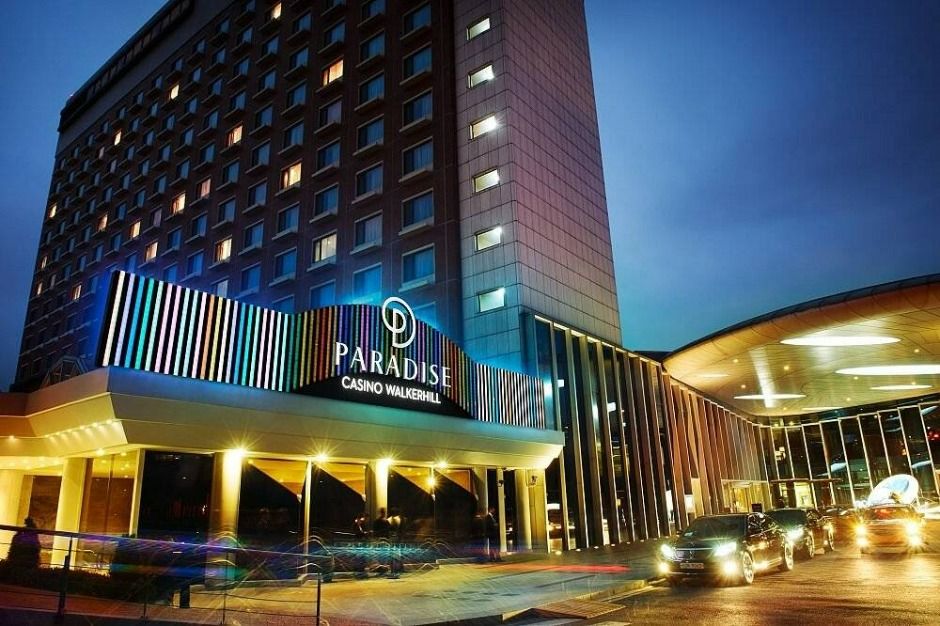
⊙ Paradise Casino Walker Hill (파라다이스 카지노 워커힐)
View detailed guide on Korea Trip Guide →
– Homepage
www.paradisecasino.co.kr
Paradise Casino Walker Hill is a foreigner-exclusive casino operating inside Walker Hill Hotel, from where guests can enjoy a fine view of the Hangang River nearby. The casino is open 24 hours a day, all year round, and offers baccarat, blackjack, roulette, and tai-sai tables among others, and a variety of slot machines as well. The game tables are run by expert dealers, and staff members are fluent in many languages to serve the customers’ needs.
](https://ktrip.blogsailing.com/wp-content/uploads/2026/03/4029506_image2_1.jpg)
![Levi’S – TIMES SQUARE Branch [Tax Refund Shop] (리바이스 타임스퀘어점)](https://ktrip.blogsailing.com/wp-content/uploads/2026/03/4024780_image2_1.jpg)
](https://ktrip.blogsailing.com/wp-content/uploads/2026/05/4023169_image2_1.jpg)
](https://ktrip.blogsailing.com/wp-content/uploads/2026/03/4024633_image2_1.jpg)