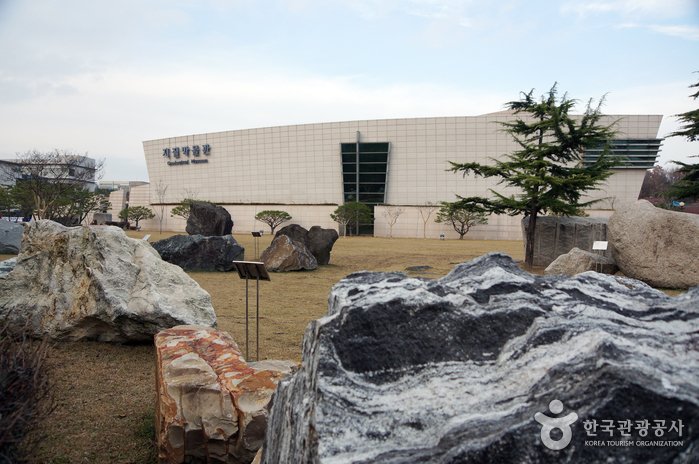
Geological Museum (지질박물관)
Geological Museum (지질박물관)
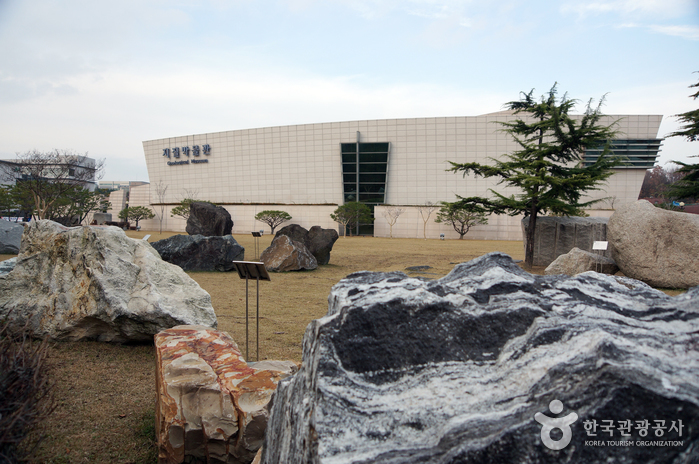 – Homepage
https://www.kigam.re.kr/museum/
The Geological Museum located in Yuseong-gu, Daejeon, is the nation’s first comprehensive museum dedicated to geology. The museum, established in 2001, operates with the goal of promoting public understanding and support of the field of geology, offering geology-related movies/videos, lectures and diverse hands-on experience programs. There is even a geology specimen center where samples are preserved for use by researchers.
– Address : 124, Gwahak-ro, Yuseong-gu, Daejeon
※ Presentation Information
– Information and Guides
• 1330 Travel Hotline: +82-2-1330
(Korean, English, Japanese, Chinese)
• For more info: +82-42-868-3798
– Parking
Available
– Parking Fee
Free
– Day Off
Mondays, the day after public holidays, New Year’s Day, Labor Day, Seollal (Lunar New Year’s Day) & Chuseok (Korean Thanksgiving Day) holidays, May 10th, temporary holiday
– Usage Fee
Free
– Operating Hours
10:00-17:00 (Last admission: 16:30)
– Scale
Building size: 1,086.24 ㎡
Total size: 2,480.58 ㎡
– Program Information
Educational programs for students and families (April-May)
* Program schedules are announced 1 month in advance on the museum website.
– Reservations
Advance reservations required through website for groups of 20 people or more


◎ Nearby Tourism Infobox
⊙ Currency Museum of Korea (화폐박물관)
View detailed guide on Korea Trip Guide →
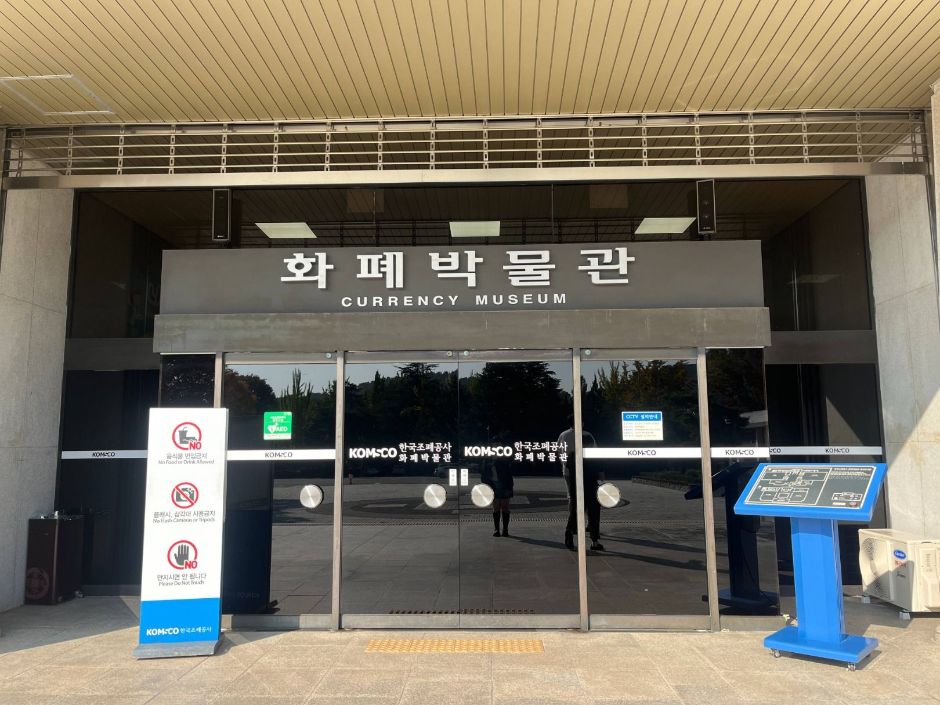
– Homepage
museum.komsco.com
The Currency Museum of Korea, established in 1988, is operated by the Mint Corporation of Korea as part of its non-profit public services and is open to visitors free of charge with a view of increasing public knowledge of the nation’s currency. The museum features about 120,000 pieces including: coins currently in use both in Korea and overseas; coins from modern times (from the Late Joseon Dynasty until today); 80 types of commemorative coins; 88 types of ‘special money’; postage stamps, and other materials. Additionally, there is an experiential space where visitors can learn about the currency production process and its historical significance, providing significant educational benefits.
⊙ National Science Museum (국립중앙과학관)
View detailed guide on Korea Trip Guide →
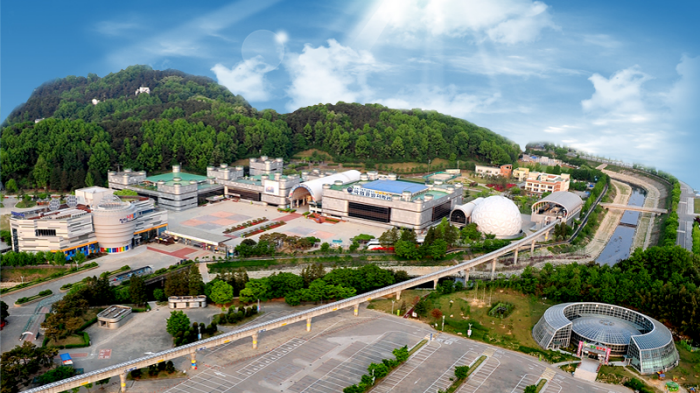
– Homepage
www.science.go.kr
The National Science Museum collects and exhibits various scientific materials. The outdoor exhibition features large models including airplanes, propellers, airboats and more as well as rest areas. The special exhibition hall displays the work of various contest winners as well as rare products. The permanent exhibition hall offers approximately 4,200 works from 322 subjects in four different fields. The observatory hall in a dome-shaped structure has a 70-millimeter-long astro-vision as well as a planetarium. Various programs are offered including HAM radio, education and experience class, model plane class, and computer class, as well as other science education programs and events.
⊙ Tower of Great Light (Hanbit Tower) (한빛탑)
View detailed guide on Korea Trip Guide →

– Homepage
www.djto.kr
The Tower of Great Light(Hanbit Tower) is an observatory located in the Expo Science Park in Daejeon. The tower is a symbolic sculpture built to commemorate the Daejeon Expo held in 1993, and is called the Hanbit Tower because it is a ray of light that connects the present and the future. The 93-meter-high Hanbit Tower offers a bird’s-eye view of the Expo Science Park and major areas of Daejeon. On the first floor, the Exhibition Room displays photos and audio-visual videos of major tourist attractions symbolizing Daejeon.
⊙ Jeongsimhwa Hall of Jeongsimhwa International Cultural Center at Chungnam National University (충남대학교 정심화국제문화회관)
– Homepage
jsh.cnu.ac.kr
(Korean only)
The Jeongsimhwa International Cultural Center is the large building on the right, just past the gate of Chungnam National University.
‘Jeongsimhwa’ is the Buddhist name of Ms. Lee Bok-Soon, who donated her lifetime savings (a total of five billion won) to the university back in 1990. She had earned the money over the course of many years by selling gimbap (rice rolled in seaweed), which currently sells for only 1,000 or 2,000 won a roll.
The cultural center was built in commemoration of the late Ms. Lee. After a series of setbacks and through the effort of many helping hands, construction was finally completed in 2000. The Jeongsimhwa Hall at the center has 1,817 seats and is used for concerts, performances, and other large-scale events. Baekma Hall (450 seats) and Daedeok Hall (200 seats) are used primarily for seminars. For visitors’ convenience, the Jeongsimhwa International Cultural Center has a parking area with space for up to 268 cars.
⊙ Daejeon Expo Aquarium (대전 엑스포 아쿠아리움)
View detailed guide on Korea Trip Guide →

– Homepage
www.djexpoaqua.com
Daejeon Expo Aquarium combines living marine life with media art. It is themed around the sea in Greek mythology, incorporating the story of Poseidon, the god of the sea, into its exhibits. Visitors can enjoy performances such as underwater ballet, feeding shows, and magic, along with activities like sea exploration boat rides, seawalker experiences, scuba diving, fish feeding, and 5D experiences.
⊙ Daejeon Shinsegae Art & Science (대전신세계 Art & Science)
View detailed guide on Korea Trip Guide →
– Homepage
www.shinsegae.com
Daejeon Shinsegae Art & Science is a culture and art complex containing cultural and art contents and the identity of Daejeon as the science capital of Korea. It was designed by a consortium of the Shinsegae Group and Kyeryong Construction Industrial and was built with five underground floors and 43 ground floors over a section of the Expo Science Park site. The complex consists of Podium (department store building) and Tower. As you can see from its name, “Art & Science,” it offers diverse contents that combine Shinsegae’s unique culture and art as well as future science and technology, from “Shinsegae Nexperium,” a science museum designed together with professors from KAIST and “Sports Monster,” the first indoor sports theme park in the region, to an aquarium with a 4,200t tank that utilizes digital media and a rooftop garden with a panoramic view of Gapcheon Stream. All of these contents that were not able to be experienced in the past attract young visitors in their 20s and 30s. In addition, it introduces exhibits of famous galleries and seeks the growth of Daejeon culture and arts through collaboration with local artists.
⊙ Smob – Daejeon Branch (스몹 대전)

– Homepage
www.smob.co.kr
Smob is the world’s first adult playground, featuring 25 attractions based on various sports that are enjoyable for everyone, including those who aren’t particularly athletic or interested in sports.
](https://ktrip.blogsailing.com/wp-content/uploads/2026/06/4019483_image2_1.jpg)
![HUGO BOSS – Hyundai Premium Outlets Daejeon Branch [Tax Refund Shop] (휴고보스 현대프리미엄아울렛 대전점)](https://ktrip.blogsailing.com/wp-content/uploads/2026/06/4044513_image2_1.jpg)
](https://ktrip.blogsailing.com/wp-content/uploads/2026/06/4029275_image2_1.jpg)
](https://ktrip.blogsailing.com/wp-content/uploads/2026/06/4028212_image2_1.jpg)
![Beanpole – Hyundai Premium Outlets Daejeon Branch [Tax Refund Shop] (빈폴 종합 현대프리미엄아울렛 대전점)](https://ktrip.blogsailing.com/wp-content/uploads/2026/06/4023495_image2_1.jpg)
One Comment