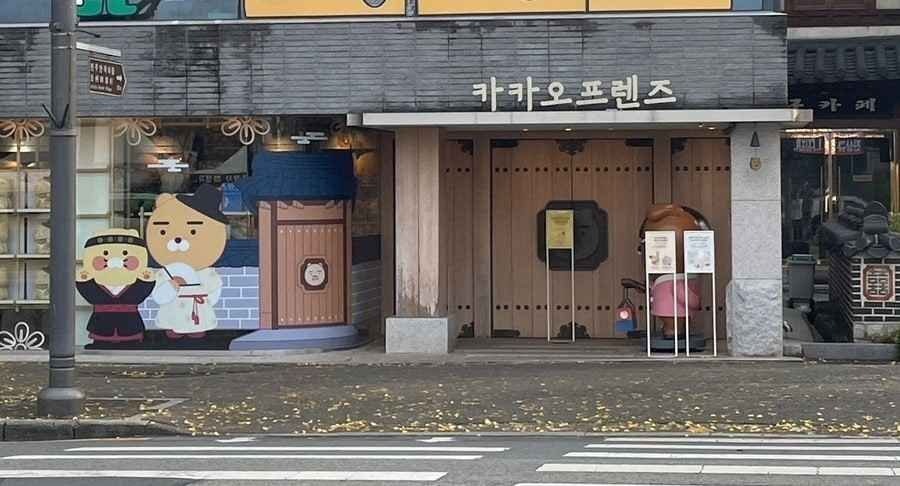
Kakao Friends – Jeonju Hanok Village Branch [Tax Refund Shop] (카카오프렌즈 전주한옥마을점)
Kakao Friends – Jeonju Hanok Village Branch [Tax Refund Shop] (카카오프렌즈 전주한옥마을점)
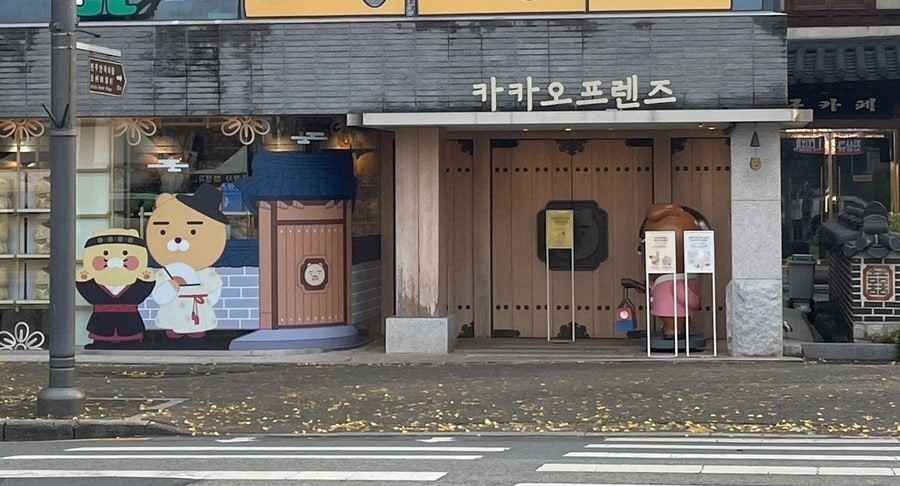 KAKAO FRIENDS is a character brand that shares the joy of everyday life through beloved characters such as Ryan and Apeach. Through witty character designs across lifestyle products and accessories, it brightens and energizes everyday life.
– Address : 1F, 126, Paldal-ro, Wansan-gu, Jeonju-si, Jeollabuk-do
※ Presentation Information
– Fair Day
Monday – Sunday
– Information and Guides
063-285-1230
– Opening Hours
11:00~20:00
– Parking
Not available
– Restroom
Not available
– Items for Sale
Miscellaneous goods
– Shop Guide
Refund method (Time-frame) : Immediate tax refund / Claim for refund
◎ Nearby Tourism Infobox
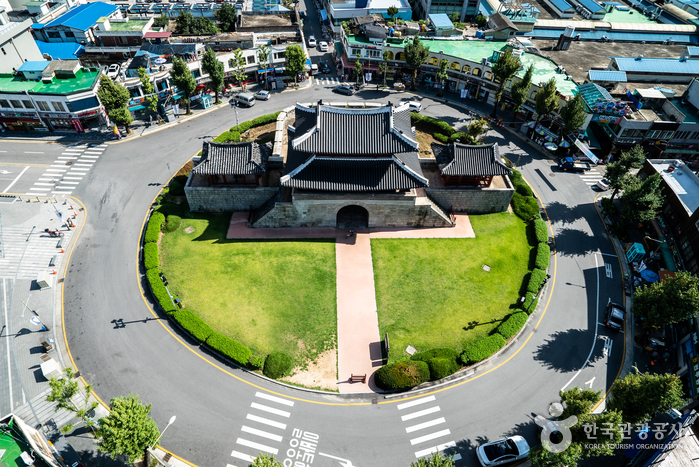
⊙ Jeonju Pungnammun Gate (전주 풍남문)
View detailed guide on Korea Trip Guide →
– Homepage
tour.jb.go.kr
Pungnammun Gate was built during the Joseon dynasty in 1734 and is a designated Treasure. Pungnammun Gate was the southernmost gate among the four city gates of Jeonju. The structure was severely damaged by fire in 1767, followed by the restoration of the gate tower afterward. The gate was burnt down once again during the Imjin War and was restored to the gate that is seen today.
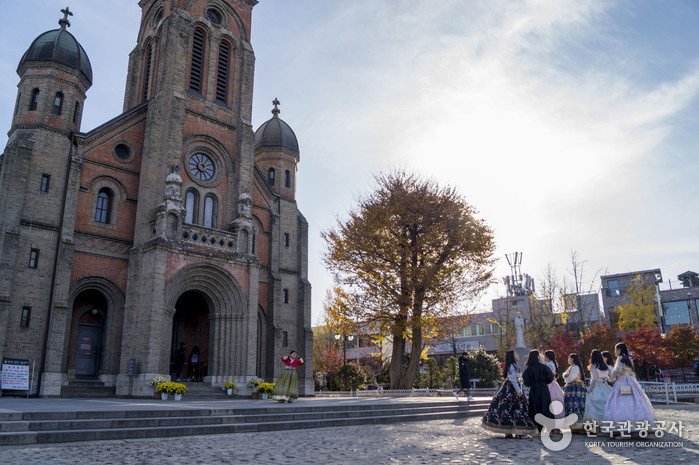
⊙ Jeonju Jeondong Catholic Cathedral (전주전동성당)
View detailed guide on Korea Trip Guide →
– Homepage
www.jeondong.or.kr
Jeondong Catholic Cathedral in Jeonju was built in honor of Roman Catholic martyrs of the Joseon dynasty on the very same spot the martyrs lost their lives. The land was purchased by French Priest Baudenet in 1891 (28th year of King Gojong), but construction of the church did not begin until 1908. Construction was completed in 1914, a time during which Korea was under Japanese rule. Though originally built just outside of Pungnammun Gate, the site of the martyrs, the church was later moved to its current location for expansion.
The first Romanesque building in the Honam region, Jeondong Catholic Cathedral is made of gray and red bricks and bears a striking resemblance to the Myeongdong Cathedral in Seoul, also designed by Priest Poinel. Not only considered one of the most beautiful Catholic churches in Korea, some even go so far as to say it is one of the most beautiful structures in all of Korea, citing the church’s unique combination of Byzantine and Romanesque architectural styles. The rectangular building is topped with three Byzantine bell towers (to the right, center, and left) and boasts arched ceilings, several of which meet in the form of a cross.
It is interesting to note that some of the bricks used in construction of the church were made using materials from the Jeonjueupseong Walled Town, which was torn down by the Japanese. It is also said that the cornerstone of the church came from a wall of Jeonjueupseong Walled Town near Pungnammun Gate.
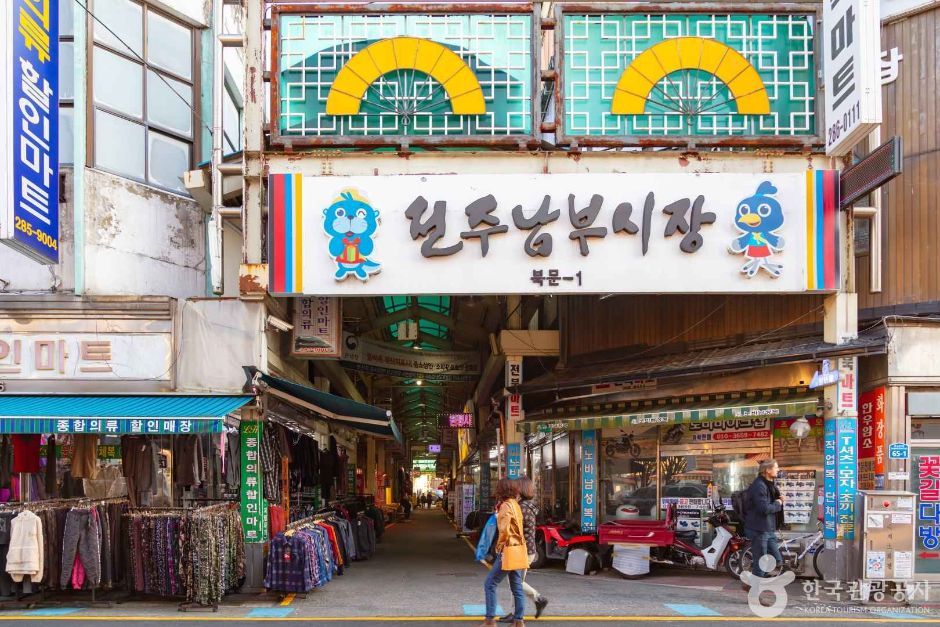
⊙ Jeonju Nambu Traditional Market (전주 남부시장)
View detailed guide on Korea Trip Guide →
– Homepage
jbsj.kr
Jeonju Nambu Traditional Market opened as a regular public market in 1905 at the site of the Joseon-era Nammunbakk Market, located just outside the Southern gate to the city. Currently the market is comprised of about 800 stores with 1,200 workers selling vegetables, fruits, food, dried fish, furniture, silk goods, and general goods.
The market was revitalized with the creation of the Youth Market, located in the previously empty shops on the second floor of 6-dong. An influx of young shopkeepers and entrepreneurs has given the marketplace an exciting vibe like that found in Hongdae or Samcheong-dong.
The night market held on Fridays and Saturdays also draws in many visitors with a multitude of delicious treats, ranging from traditional dishes such as nokdujeon (mung bean pancake) to fusion treats like bibimbap served in rice paper like a spring roll.
⊙ Royal Portrait Museum (어진박물관)
View detailed guide on Korea Trip Guide →
– Homepage
www.eojinmuseum.org (Korean only)
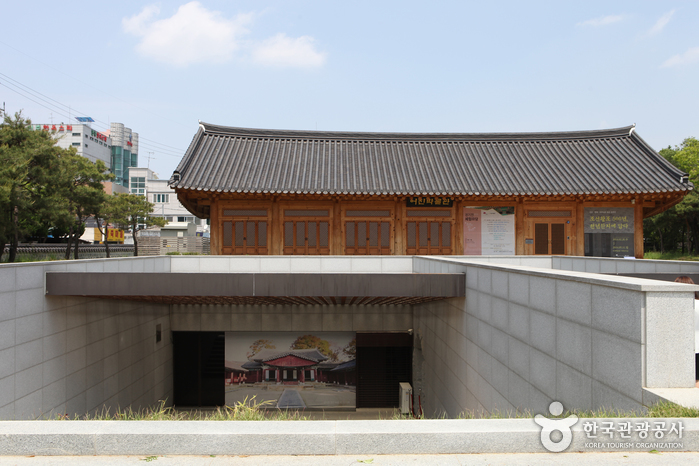
Opened on November 6, 2010, the Royal Portrait Museum is one of the newest attractions of Jeonju, located within the Gyeonggijeon Shrine. Royal Portrait Museum is a valuable museum as a new tourism resource of Jeonju as well as Gyeonggijeon Shrine and the Portrait of King Taejo, as well as other various high-class exhibitions to preserve, manage, and enhance the glorious cultural assets of Joseon royal family. The museum is comprised of one above-ground level and one underground level with an area of 1,193.71 square meters. The Portrait of King Taejo and six other king’s portraits (Portrait of King Sejong, King Yeongjo, King Jeongjo, King Cheoljong, King Gojong, and King Sunjong) are exhibited on the first floor. The portraits are preserved in temperature- and humidity-controlled cases. In addition, the museum houses History Hall, Palanquin Hall, a planned exhibition hall, resting area, management office and storage room for relics. Palanquin Hall exhibits Hyangjeong (Palanquin for Incense Burner and Case), Sinyeon (Palanquin for Royal Portrait and Palanquin for Mortuary Tablet), Chaeyeo (Palanquin for High Officials), Gagyo (Palanquin for Ritual Items) featuring Korea’s sole preserved palanquin. History Hall houses approximately 80 relices related to Gyeonggijeon Shrine and Jogyeong Shrine, ancestral ritual ceremony, building, and others relics. Since the museum’s opening, it makes continual efforts to become a central place for Jeonju residents to fulfill their cultural feelings. The museum operates various program like exploring famous historic sites in Gyeonggijeon Shrine, hands-on programs such as a guard experience to protect the shrine, and duplicating Gyeonggijeon Shrine’s relics using traditional portrait-making techniques.
⊙ Veteran Kalguksu (베테랑칼국수)
View detailed guide on Korea Trip Guide →
– Homepage
https://smartstore.naver.com/veteran1977/
Veteran Kalguksu, located in Jeonju Hanok Village, has been operating since 1977, attesting to the great taste of their broth, made using sesame, meal, and eggs. The noodles are also cut much thinner than other restaurants, while maintaining their chewy texture. Another popular menu at the restaurant is their kongguksu.
◎ Travel information to meet Hallyu’s charm
The restaurant was a favorite spot for the cast of the drama “Twenty Five Twenty One.” Lead actress Kim Tae-ri, who played Na Hee-do, even visited for breakfast during her vlog shoots. She drew attention for enthusiastically finishing a bowl of noodles down to the last strand. Nearby is the private rental house “2521,” which was featured as Hee-do’s home in the drama, making it worth visiting after enjoying a meal at the restaurant.
⊙ Han Kook Jib (한국집)
View detailed guide on Korea Trip Guide →
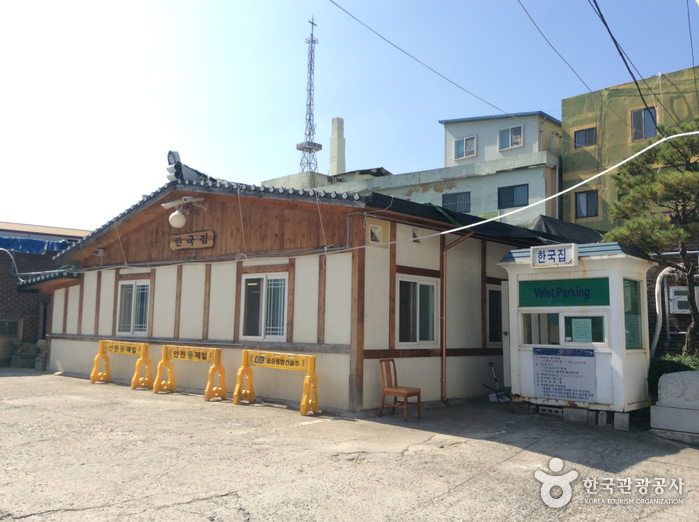
Opened in 1952, Han Kook Jib has upheld its tradition for three generations. It is housed in a renovated hanok with a beautiful courtyard. Han Kook Jib is conveniently located near major tourist sites in Jeonju, such as Jeonju Hanok Village and Gyeonggijeon Shrine.
⊙ Neulbomstay (늘봄스테이)
View detailed guide on Korea Trip Guide →
– Homepage
http://yeohangga.modoo.at
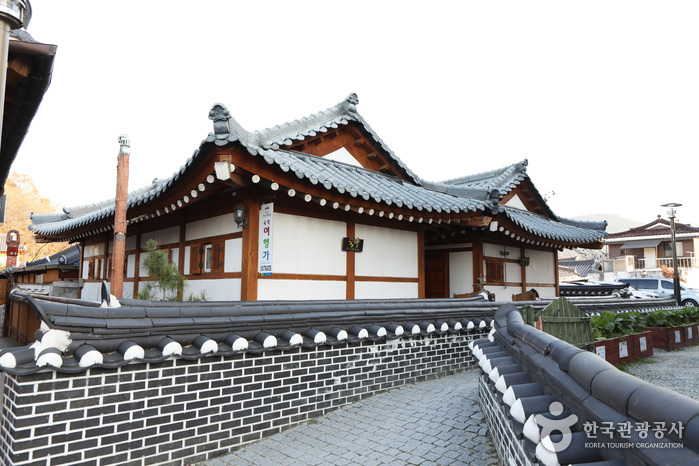
The Traveler, located in Jeonju, Jeollabuk-do, is a pleasant place to stay for families in particular. Apart from the charm of staying in a hanok, visitors can experience traditional games of chance like the Twelve Bridges Game and the Pumpkin Wheel Game. Each room is equipped with a bathroom/toilet, and residents can use the kitchen in the main house to prepare meals.
⊙ Jeonju hanok house (전주 한옥숙박체험관)
View detailed guide on Korea Trip Guide →
– Homepage
http://hanok114.kr
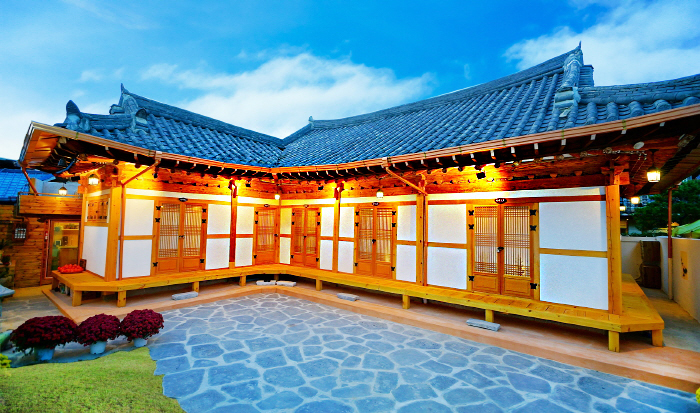
Jeonju Hanok stands at the end of a quiet alley off Eunhaeng-ro in the center of Jeonju Hanok Village, and so is a good base for exploring the village. All guest rooms are ondol-heated and have a loft space that’s popular with children. Water purifiers are installed, and a breakfast of toast, fruit and tea or coffee is provided. The outdoor yard has a table where visitors can relax in good weather.
⊙ The Hanok (더 한옥)
View detailed guide on Korea Trip Guide →
– Homepage
http://thehanok.modoo.at
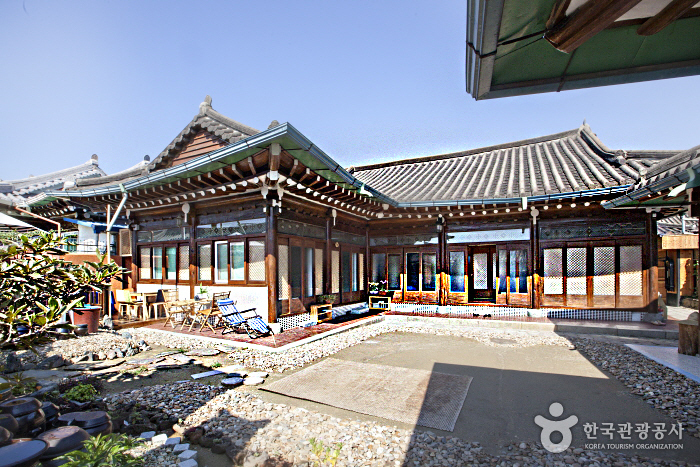
The Hanok, located in Jeonju, Jeollabuk-do, is a large hanok guesthouse built of beautiful tradition materials – cypress wood, red clay, and traditional hanji paper. The largest of the 7 rooms (Gwibin – ‘Special Guest’) has a king-size bed, ondol underfloor heating, and a massage bed, making it suitable for two families. One room has an attic, one has an red clay bed, and one has a bunk bed made of re-used traditional materials. In the spacious yard, guests can enjoy delightful moonlight tea parties.
⊙ Fine day (좋은날)
View detailed guide on Korea Trip Guide →
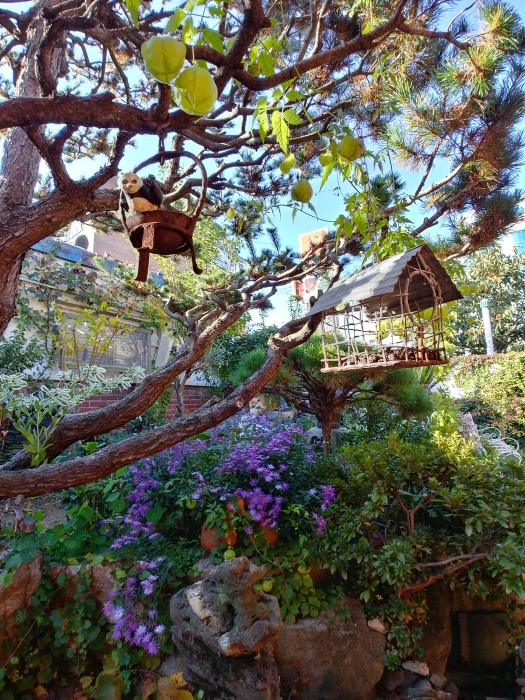
A Fine Day is a hanok stay on Jeondong Cathedral Street, Jeonju, Jeollabuk-do, which combines hanok tradition with modern convenience. The wood floor and red clay-lined walls and ceilings are a pleasure to wake up to. The rooms are well heated and have toilets, shower booths and bidets. From the wooden porch guests can enjoy a beautiful sunny garden planted with wildflowers and trees. Nearby attractions include Gyeonggijeon, Omokdae, Jeondong Cathedral and Nambu Market (great for food!).
![Seoneulgi Culture [Korea Quality] 서늘기문화[한국관광 품질인증]](https://ktrip.blogsailing.com/wp-content/uploads/2025/12/3042325_image2_1.jpg)